 Layerzeroscan
 tracks messages across blockchains
Layerzeroscan connects LayerZero messages to source transactions, verifier results, and available destination transactions in a cross-chain explorer. It shows where a message originated, which contracts participate, and whether destination execution has occurred. Transaction and address searches support individual lookups, while the public API supports reporting across applications and pathways. These linked records help distinguish a completed source transaction from successful execution on another blockchain, with the application’s configuration providing the context for its verification results.
LayerZero verification requirements follow the application’s active pathway settings, which can differ between directions connecting the same chains.
Transaction and address searches
A transaction hash or participating address provides a starting point for finding LayerZero messaging activity across the relevant blockchains. The search supports source or destination transaction hashes, contract addresses, and user addresses. Message views bring connected transaction details together, while address views organize activity involving the selected address. These entry points answer different questions: a hash locates a transaction, while an address groups related activity. The application contracts in a record identify the messaging participants, which can differ from the wallet initiating the operation.
Recent-message listings also show source and destination chains, participating addresses, and timestamps. They offer a view of recent activity without requiring a specific transaction hash.
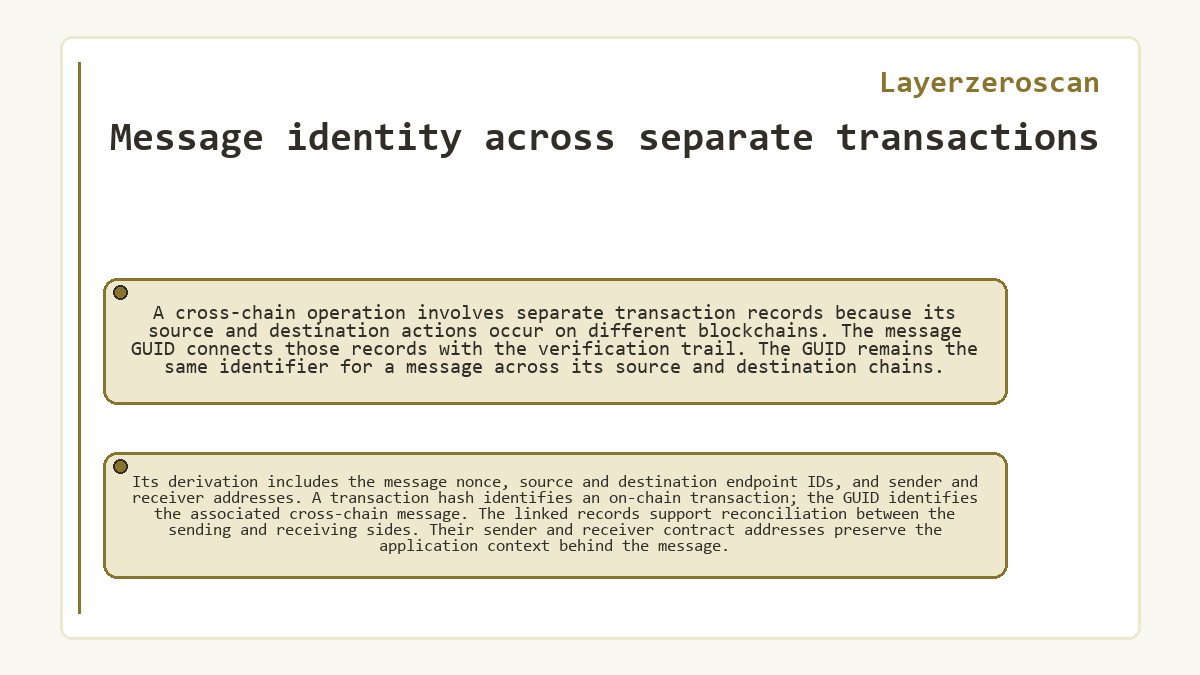
Message identity across separate transactions
A cross-chain operation involves separate transaction records because its source and destination actions occur on different blockchains. The message GUID connects those records with the verification trail. The GUID remains the same identifier for a message across its source and destination chains. Its derivation includes the message nonce, source and destination endpoint IDs, and sender and receiver addresses. A transaction hash identifies an on-chain transaction; the GUID identifies the associated cross-chain message.
The linked records support reconciliation between the sending and receiving sides. Their sender and receiver contract addresses preserve the application context behind the message.
Which verification settings govern a message?
For a LayerZero V2 message, the application configures verification for the specific pathway and direction, including its Decentralized Verifier Networks (DVNs). The reverse direction can use different settings even when the same chains participate.
Required verifiers and an optional verifier set have different obligations. Every required DVN must verify, while a configured threshold determines how many optional DVNs must verify. A required DVN that stops verifying halts verification on its configured pathway.
The default checker displays pathway settings for message libraries, verifiers, executors, and confirmation requirements. Those defaults describe a baseline configuration for the selected direction.
Application-specific settings can override defaults. Configuration tooling distinguishes the application’s own settings, LayerZero’s defaults, and the active combination. The active view identifies the settings the application actually uses. Reading a default listing alone does not establish the verification configuration of a particular deployment.
What does a message status confirm?
A message status describes progress through source confirmation, verification, and destination execution, with separate fields identifying the state of each component. In the Scan API, DELIVERED means the message executed on the destination chain. INFLIGHT can cover waiting for source confirmations, verification, or execution. CONFIRMING means the destination transaction awaits finality. Successful source confirmation establishes the source stage without establishing destination completion.
Verification results answer a narrower question than destination execution. A verifier can finish its work while the destination stage still waits. The receiving application’s logic determines the effect of execution, including any token-specific handling.
An application report with a defined scope
A reader wants a report limited to one application deployment. The contract address and its LayerZero endpoint ID are hypothetical inputs for this worked example. The question is which messages belong to that deployment, rather than every transfer involving the same blockchains.
The omnichain application (OApp) lookup accepts an endpoint ID and application address together. Using those inputs produces a message set associated with that deployment. Its records connect the application’s messages with source transactions, verification information, and destination transactions when available.
A pathway lookup selects an identified messaging connection, while a GUID selects an individual message. The deployment report does not automatically include all messages involving the application’s contracts at other endpoints. Using the OApp lookup for those deployments requires their corresponding endpoint IDs and addresses.
Automated reports and pagination
A reporting integration uses the public Scan API to retrieve message records for dashboards, reconciliation, or transaction investigations. Transaction, GUID, pathway, wallet, and application queries provide different ways to select message records. Application and pathway endpoints support start and end dates plus paginated results. A response can include
nextToken
for retrieving the next result set. A first response therefore need not contain every matching message within the selected period. A report’s coverage follows its query scope, date filters, and retrieved pages.
Mainnet and testnet use separate API services. Keeping the environment with an exported report prevents test activity from being mistaken for mainnet activity.
Issuer controls behind token transfers
Token transfers can involve issuer controls beyond the messaging layer, and those contract rules affect how a destination operation handles the asset. The Omnichain Fungible Token (OFT) standard supports a token’s cross-chain supply model. Issuers using controlled-token extensions can configure allowlists, blocklists, pauses, and rate limits. In the stablecoin OFT extension modules, a destination-specific pause stops outbound transfers toward the selected chain. A global pause has a broader scope across token operations. Rate limits can apply per destination or use a shared bucket.
Some controlled-token implementations can route an inbound credit for a recipient outside the allowlist to issuer-controlled escrow. This branch lets the message settle while the issuer reviews the recipient. Message delivery therefore does not always mean immediate availability in the intended recipient’s balance. The token implementation determines whether that escrow branch applies.
Fees and destination execution resources
Message costs reflect the selected networks, verification services, and destination execution requirements. The detailed explorer view can show gas usage and bridging fees. LayerZero V2 separates source-chain transaction costs, DVN fees, executor fees, and destination gas funding. The receiving contract’s work affects destination gas requirements. Gas prices and native-token conversion rates can change the cost of funding that work.
On-chain quote mechanisms calculate fees before submission using the message’s current inputs. A previously displayed amount does not establish the cost of another pathway or a later transaction.
Common questions
Can I retrieve a message record without signing a blockchain transaction?
The public Scan API retrieves message records without a blockchain transaction signature. Read requests use identifiers such as a transaction hash or GUID. This lookup reads messaging data and does not authorize a token transfer or modify an application. A seed phrase or private key is not an input for retrieving the record.
Are LayerZero endpoint IDs the same as blockchain chain IDs?
LayerZero endpoint IDs and blockchain chain IDs are different identifiers. An endpoint ID identifies the LayerZero endpoint for a network, including networks outside the Ethereum Virtual Machine ecosystem. Application-message queries expecting an endpoint ID need that identifier. A blockchain chain ID does not serve as an interchangeable substitute.
Does the wallet query include every message an address receives?
The Scan API’s wallet query selects messages initiated by the address on the source chain. It does not establish a complete history of every inbound message or every appearance of that address.
Will an address lookup identify the person behind a wallet?
A wallet address alone does not establish its holder’s legal identity. Explorer records associate addresses with contracts and cross-chain activity. Sharing a transaction alongside personal information can make that activity attributable to a person. The record remains evidence of blockchain activity without proving who controlled the address at a particular time.
What does a Dead DVN mean in default settings?
A Dead DVN is a placeholder for an inactive default verification configuration. It does not supply the live verification a pathway needs. The application owner must configure valid verification settings before using that pathway. This placeholder indicates a configuration dependency and does not establish that an underlying blockchain is offline.
Which format does the Scan API return?
The Scan API returns structured JSON message records. Collection responses include a data array and can include a pagination token. Reporting software can read separate transaction, verification, configuration, and status fields from those records. This supports programmatic processing without depending on the explorer’s visual page layout.
When does the compose status show N/A?
The lzCompose status shows N/A when the message has no compose operation. This field describes an additional composed call, with its own execution status when applicable. N/A identifies an operation outside that message’s scope; it does not by itself indicate that the main message failed.
- last updated